


Culture: How to Start a Small Resistance in the Face of Fascism
Updated: Jul 20, 2025
When the lines between what is true and false, a fact and an opinion, a snippet and the whole picture are blurred, society becomes more extreme. We need to delineate the lines again.
During my relaxing beach holiday this year, I opted for a calming book, and what better choice is there than On Tyranny by Yale Historian Timothy Snyder? If you are unfamiliar with Timothy Snyder, he taught at Yale for over 20 years and is an expert on Russia, Ukraine, and totalitarianism in 20th-century Europe. His 2017 book On Tyranny recently re-emerged on the New York Times Bestseller List (I wonder why...), and it caught my eye. During a time when everything seems eerily familiar, like a reflection of horror's past, I wanted to educate myself on the rise of extremism on both ends of the political spectrum, as well as cultural shifts towards ideologies of suspicion.
Snyder's book provides the reader with 20 practical strategies to resist tyranny, drawing on lessons learned in Europe during the 20th century. I won't list all 20 lessons because I highly recommend reading the book yourself; it's only 120 pages and can be read in a day. In addition, there is a variety of Timothy Snyder's lectures available on YouTube, and they have been my favourite comfort show since WWIII murmurs started. However, there was a common thread throughout the entire book that stood out to me, which I believe deserves further discussion.
Snyder mentions Romanian playwright Eugene Ionesco and his most famous work, Rhinoceros. The play explores how the protagonist's circle of artists and intellectuals all fell prey to the far-right, NAZI sympathetic movement "The Iron Guard" in Romania of the 1940s. Every time one of his friends would surrender to the ideology, the character would transform into a Rhinoceros.

Shamefully, especially as someone with a Romanian background, I was completely unaware of Ionesco and his symbolic play, which is happening in real-time all over the world. I know people who have become rhinoceroses. At first, it always starts with "I don't agree with everything they say, especially about these people. They only say that for attention. But this one thing he says, he's right...". Before you know it, they have suspended all rationale and fully immersed themselves in the ideology altogether. How do we stop these rhinoceros metamorphoses from happening?
Going back to basics, we need to define what fascism is and why it is bad. Once we truly understand the telltale signs and characteristics, only then can we hope to implement acts of resistance in our daily lives. According to Professor Timothy Snyder, the far-right political movement of fascism starts with the destruction of truths, so they can build a political reality based on fiction. Myths about a nation, its leader and people will emerge, like Hitler's fanaticism on the superior German race. This myth supposes that a nation has inherent superiority, and so it justifies the steady discrimination against others, even to the point of genocide. In fascism, people are not individuals with rational minds but rather part of a tribe whose first order is to fight the enemy. Only the leader has the might to do this in the name of the people.
The "Make America Great Again" slogan is based on the myth that America had a great time to revert to. When exactly was that? During the financial crisis of 2008? Post 9/11 and the Iraq invasion? The civil rights movement? WWII? Through the erosion of history, Trump fabricates an America of Fiction, wherein each citizen can be proud of their patriotism, which the left had made them feel guilty for.
Out of this fictional history emerges an ideology of suspicion. Don't trust traditional media; they are sponsored by the state and, therefore, have an agenda to lie to you. Don't trust science and medicine; the pharmaceutical industry profits off of sick people, so they will make you sick on purpose. Also, man-made climate change isn't real; it is just another attempt by socialists to control and over-regulate free enterprise, thereby limiting your freedoms. The consistent message is to be suspicious of all information, for everything can be propaganda. Believe none of it, but believe when we tell you to believe none of it.
Consequently, fascists create a demographic that rests on the foundation of a glorified fictional history and an ideology of suspicion. In this political climate, truth and falsehoods vanish. Only the word of the leading party matters. Normally, when a politician states a falsehood and is called out on it, he retracts his statement and issues an apology. Trump denies ever having said so, even if it was on record, and shifts the blame, accusing the accuser of apparent falsehoods. To the viewer, confusion will have blurred the lines of what to believe. Most people will choose to believe whoever they can identify with the most, or whoever has the most power behind them, like a president would.
During his first term, Trump averaged about 22 lies a day, and the media paid heed to all of them, even if in outrage. Through the pervasive regurgitation of lies, the truth becomes obscure as well. Following this, it is easy for Trump to call journalists and reporters "fake news", not unlike how Hitler denounced the Jewish "Lügenpresse" (press of lies) to increase public suspicion of media outlets daring to speak against him.
In a world dominated by the dissemination of knowledge through social media, this should ring all alarm bells. In a previous article, I argued that social media hate trains against female celebrities are a reflection of the algorithm's pattern for promoting insidious content based on your emotional proclivities. In other words, the more enraged or fanatically in agreement you are, the more likely content will be shown to you. The extremes of these insidious posts go completely unregulated, in a way that books and traditional media could never get away with. This clearly demonstrates that we live in a society that values the emotional opinion of someone speaking on social media, being applauded by thousands of likes and views, far more than the meticulously researched, fact-checked, and peer-reviewed work of truth seekers: journalists.
People argue that traditional media has an agenda and is, therefore, propaganda, whereas individuals on social media only speak their truth. Is it truly their own truth made from introspection and critical thinking, as well as book-based education? Or is it just another opinion from someone else they saw on the digital sphere, whose likes and views propelled them to the hall of fame and virality? Even in my article about fashion trends since 2020, I argue that social media essentially created style eco-chambers of categories that make us dress all the same, effectively eliminating innovation and originality. Similarly, social media discourse on politics creates echo chambers of extreme radical opinions because they are the loudest, thanks to the algorithm. Moderate voices are never as promoted.
Additionally, Professor Timothy Snyder points out how Russia runs a cyberwar on the West to weaken it from within. It is proven that Russian bots or Russian-funded influencers helped to win the 2016 and the 2024 elections for Donald Trump. By analysing topics sensitive to the US public, these Russian agents created content on social media that would push the right buttons for Americans to vote for Trump. They have been attempting this type of psychological cyber-warfare since Soviet times during the Cold War. Only back then, people predominantly lived in a three-dimensional world, reading, writing, and talking to each other, so the Soviet mission failed. Nowadays, the world has changed drastically. We predominantly live in a mostly unreal, two-dimensional world through our screens.
It is important to note that this cyberwar not only occurs politically, but also culturally. Men and women have never been more divided, pinned against each other online, and it is causing real division. Fewer people date, get together, find social belonging and a support network. This, too, affects the mental strength of people to resist any form of tyranny. In fact, it makes them more prone to support it, as is often the case with incels promoting far-right political ideologies.
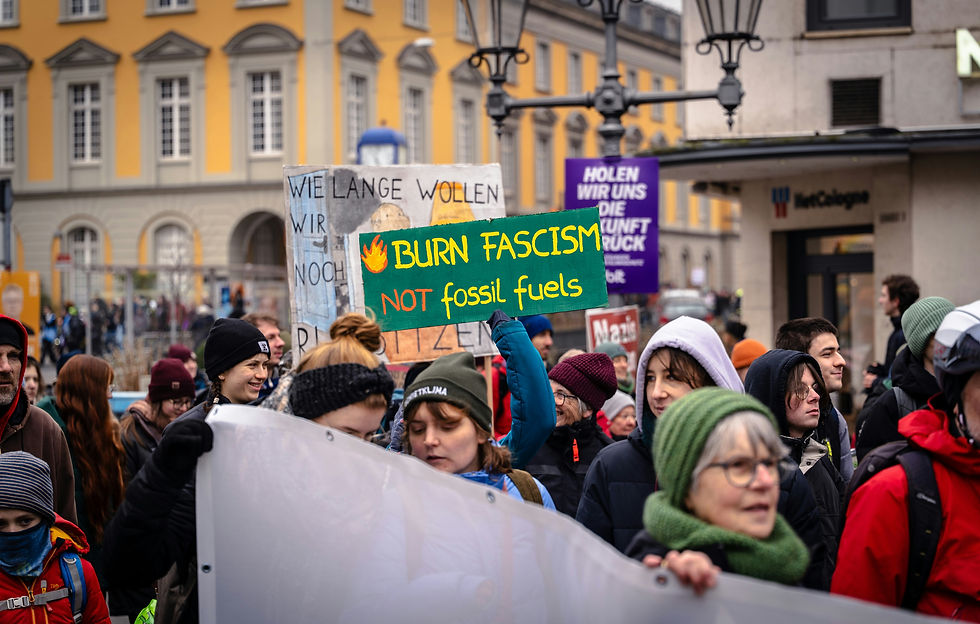
This leads me to the main point of this article, on how to resist fascism in our daily lives. How do we not become rhinoceroses? Drawing on Prof. Timothy Snyder's On Tyranny, the consensus of his 20 insights is to spend less time on digital media, trust the work of truth-seeking mainstream media (which is no longer mainstream in this podcast and TikTok-dominated media landscape, reading the Guardian is actually quite cool and edgy now), and reach out to people different from you to start in-person dialogues.
The less time you spend on social media, the less likely you will be exposed to bots, Russian propaganda, and the social media oligarchy of people with a phone and an opinion but no skill for research. Instead, reach out to people who are already in your life and to strangers, too. Try to lead civil conversations about your differences, but find commonality in your love for freedom from tyranny.
For example, when the war in Ukraine broke out, my social media feed was full of videos of bodies in white body bags to demonstrate the atrocities happening, only for one of the bodies to stand up and walk away, after the media coverage had stopped recording. I did not believe it, because I was privileged enough to attend an international high school, where I made many Ukrainian friends. Instead of believing what was most likely Russian propaganda, I just talked to my friends and asked them about their family's well-being and lived experiences. What they told me was the opposite of what social media would have liked me to believe.
You might think this is an obvious example, and one should hope so, but I did have to spend my days convincing people these videos were fake. I heard "why do we send our tax money to Ukrainians, they should just surrender if they don't want anyone to die." They were people who spent more time online than talking to real people, whose lives were affected. Rhinoceroses.
Another example is my lovely neighbour who probably has lube, tissues, and Mein Kampf in his nightstand. After repeatedly insulting my mom for being Romanian, with nonsensical insults like "you people" (it lacks creativity, he could say gypsies, thieves, welfare state parasites, but he knows we pay more taxes than him, so to his chagrin, he has to resort to the least offensive phrase). Yesterday, he told me "you people" have a problem with property, and I countered with facts I read from a history book. "Historically, Austrians occupied other countries and plundered them for their imperial interests, so if a national character, if such a thing exists, exhibits traits of property violations, it would be Austrians." Completely went over his head, of course, but my own level of education amused me and kept me standing my ground, even if uncomfortable amidst his presence and abuse.
After you read this article, get off the screens and talk to people in real life. Stay connected with truths, don't let them confuse you, educate yourself from books, and most of all, think to yourself, "Who does this policy benefit and at the expense of whom?". Democracy is run by the majority, so form a majority with people you might not agree with on all fronts, but who also oppose tyranny. Coalitions have been the only technique in history to effectively prevent a fascist government from forming. And please, call out ideologies you find inhumane, even if it's your neighbour, and he wants to make you feel uncomfortable in your own home. Resist.


Comments